

Instant Failover (Same Static-IP)
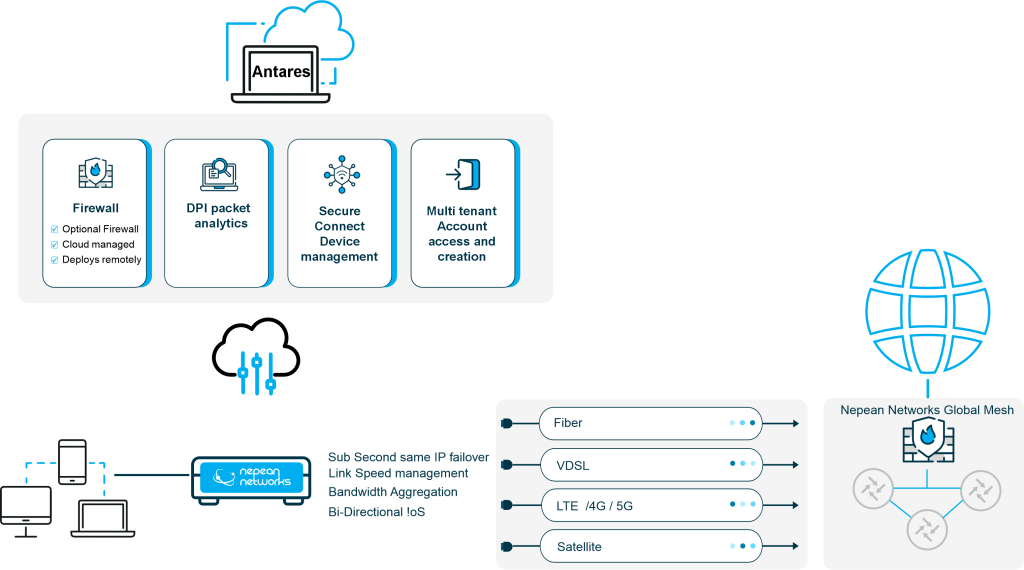
Never drop a connection again. Nepean Networks’ Instant Failover keeps your business online the moment a link fails or degrades — rerouting traffic automatically, in under 300ms, without changing your IP address. It works across any mix of connection types — 4G/5G, VDSL, fibre, MPLS, and Starlink — and scales from single-site SMBs to multi-site enterprises. For MSP resellers, real-time alerts mean you can resolve an outage before your client even notices.
Failover isn’t a feature we bolted on to SD-WAN — it’s where Nepean Networks started. We’ve been building broadband bonding and failover services since 2010, when the company began (as Fusion Broadband in Australia) helping businesses build more reliable connections.
How It Works
Automatic, per-packet failover — if the primary link fails or degrades, traffic reroutes to the best available path with no manual input and no change of IP address, so nothing needs to re-authenticate or re-establish a session.
Supported Connection Types
Automatic, per-packet failover — if the primary link fails or degrades, traffic reroutes to the best available path with no manual input and no change of IP address, so nothing needs to re-authenticate or re-establish a session.
Built for MSPs
Real-time reseller alerts, full white-label, and deployed across 200+ partners spanning Australia, Asia, North America, the UK, South Africa – anywhere in the world.
Instant Failover vs. Internet Acceleration (Link Bonding) — Which Do You Need?
Different problems: Failover is redundancy — switching to a backup link the instant your primary connection drops. Link Bonding is throughput — combining multiple links simultaneously (per-packet, with proprietary tunnelling) to increase available bandwidth.
What Our Partners Say
“Talking Business Co has partnered with Nepean Networks for many years to provide stable bonded internet solutions to our customers — be it for simple fail-over or for full performance resilience bonding. Their reliability is second to none and I highly recommend their services.”
— Brett Merriman, Talking Business Co
Ready to Transform
Your Network?
Discover how SD-WAN can revolutionize your business. Book a demo with our experts to see the technology in action and explore tailored solutions for your needs.
Frequently Asked Questions
What happens to my connection during a failover — do I get disconnected?
How fast is the failover, exactly?
Is failover automatic, or does someone need to trigger it?
What connection types can be used for failover?
Does this work with Starlink specifically?
Can it be combined with other WAN types in a hybrid setup?
A: Yes — hybrid WAN deployments combining MPLS, broadband, LTE, and Starlink run under a single, unified management framework, so a multi-site business doesn’t need identical connection types at every location.
What's the difference between Instant Failover and Internet Acceleration (Link Bonding)?
A: Two different problems. Instant Failover is redundancy — it holds a backup link ready and switches to it automatically, keeping the same static IP, the moment your primary connection fails or degrades. Internet Acceleration (Link Bonding) is throughput — it combines multiple links simultaneously, using a per-packet approach with proprietary tunnelling technology, to increase available bandwidth for every flow rather than just holding one in reserve. Many customers run both together: bonded links for day-to-day performance, failover protecting against a link going down entirely.
Is this only for large enterprises, or does it work for small single-site businesses too?
A: Built to scale from single-site SMBs to multi-site enterprises. The same platform runs across Nepean’s 200+ MSP and ISP partners, serving customers in banking, healthcare, education, government, and manufacturing, among other sectors — see About Us.
As an MSP reselling this, will I know when a failover event happens for a client?
A: Yes — resellers get real-time alerts, so an outage can be identified and resolved before the client notices, rather than waiting for them to report it. Details on reselling under your own brand are on the Become a Partner page.
How long has Nepean Networks been providing failover services?
A: Since 2010. Broadband bonding/aggregation and failover were the company’s original services, launched under the Fusion Broadband name in Australia, before the platform evolved into the full modular SD-WAN offering Nepean provides today.