
As IT and Operational Technology environments become increasingly connected, simply knowing a device is online is no longer enough. Network teams need visibility into what those devices are actually doing.
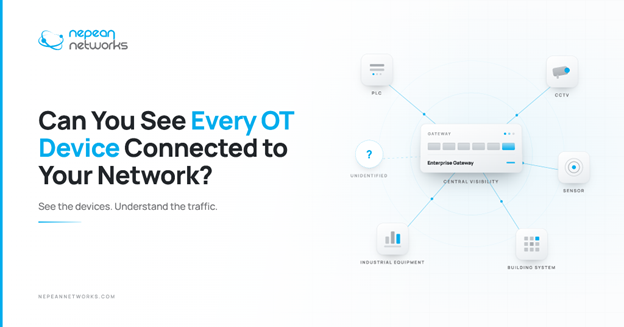
PLCs, CCTV cameras, environmental sensors, building management systems, access controls and industrial equipment are becoming part of increasingly connected environments.
For network and security teams, this creates an important question:
Can you see every OT device connected to your network?
And perhaps the more important question:
Can you understand how those devices are communicating?
Traditional network monitoring provides essential information about availability, uptime and infrastructure health. Endpoint security can provide detailed information from systems capable of running an agent.
But Operational Technology, or OT, introduces a different visibility challenge.
Many OT and IoT devices are purpose-built. Some use specialised or legacy operating systems. Others have limited resources or cannot practically support conventional endpoint monitoring agents.
They may still be communicating across the network every day.
Understanding that traffic can provide valuable context for network operations, troubleshooting and security investigation.
What Is Operational Technology?
Operational Technology refers to the hardware and software used to monitor, control or automate physical equipment, facilities and industrial processes.
Depending on the environment, this can include:
- Programmable Logic Controllers (PLCs)
- Industrial sensors
- CCTV and surveillance systems
- Building Management Systems (BMS)
- Access control systems
- Manufacturing equipment
- Environmental monitoring equipment
- Industrial controllers
- Other connected IoT and operational devices
Unlike conventional IT endpoints, many of these systems were designed primarily to perform a specific operational function.
They weren’t necessarily designed around modern endpoint monitoring.
Yet IT and OT environments are becoming increasingly interconnected.
That makes OT network visibility increasingly important.
The OT Visibility Gap
Consider a CCTV camera operating inside an enterprise facility.
Traditional monitoring might tell the network team that the camera is online and reachable.
Everything appears healthy.
But that doesn’t necessarily answer:
- Where is the camera communicating?
- Which protocols or applications are involved?
- How much traffic is it generating?
- Has its communication pattern changed?
- Is it connecting somewhere unexpected?
The same questions apply to PLCs, sensors, building systems and other operational devices.
A device can remain completely operational while its network behaviour changes.
If your monitoring strategy focuses primarily on whether the device is available, those changes may be difficult to understand.
This is where network-level traffic visibility provides another perspective.
Why Endpoint Monitoring Alone May Not Cover Every OT Device
Endpoint agents play an important role in modern IT and cybersecurity environments.
But they aren’t suitable for every device.
Installing additional software on a laptop or server is very different from installing it on an industrial controller, sensor, camera or specialised operational system.
Depending on the device and environment, an endpoint agent may be impractical because of hardware limitations, operating-system compatibility, vendor restrictions or operational requirements.
This creates an important distinction:
No endpoint agent should not automatically mean no network visibility.
Rather than relying exclusively on software installed on individual devices, network teams can also observe the traffic those devices generate as it crosses the network.
This provides another source of evidence for understanding device behaviour.
Look Beyond “Is It Online?”
Traditional network monitoring answers an essential question:
Is the infrastructure working?
That’s important.
But modern network operations increasingly require another layer of understanding:
What is actually happening across that infrastructure?
Suppose a network link is healthy and an OT device is online.
From an availability perspective, everything may appear normal.
But underneath that healthy status, the device might have:
- Started communicating with a new destination
- Generated significantly more traffic than usual
- Changed the protocols it uses
- Started communicating at an unexpected time
- Created traffic that deserves further investigation
These observations don’t automatically indicate a cybersecurity incident.
But they provide valuable context.
Where Deep Packet Inspection Adds Context
Basic traffic statistics can tell you that data is moving across the network.
Deep Packet Inspection (DPI) can provide deeper application-level context around that traffic.
Rather than looking only at connections or bandwidth consumption, DPI can help classify traffic and provide greater understanding of application usage and network behaviour.
For network teams, this can help answer questions such as:
- Which applications are consuming bandwidth?
- What traffic is associated with a particular device?
- Which applications and protocols are active?
- Which devices or applications are generating significant traffic?
- What changed when network performance deteriorated?
This application awareness can be useful across traditional IT environments as well as networks containing IoT and OT devices.
It changes the conversation from simply measuring traffic volume to better understanding what that traffic represents.
Unusual Behaviour Is a Signal, Not a Verdict
Visibility needs to be used carefully.
Imagine an industrial device suddenly communicating with a destination it hasn’t previously contacted.
That deserves attention.
But it doesn’t necessarily mean the device has been compromised.
There may be a legitimate explanation.
A vendor configuration may have changed. A service may have been updated. A new operational process may have been introduced.
Similarly, an unexpected increase in bandwidth might represent a legitimate data transfer rather than malicious activity.
This is why context matters.
Instead of immediately treating every deviation as a security incident, network and security teams need enough information to investigate intelligently.
Useful questions include:
- What device generated the traffic?
- What does that device normally do?
- Where did the traffic go?
- Which application or protocol was involved?
- What changed?
- When did the change occur?
- Is there a legitimate operational explanation?
The objective isn’t to create more alerts.
It’s to make the available signals more useful.
OT Visibility Is Not Just a Cybersecurity Issue
It’s easy to frame OT visibility entirely around cyber threats.
But the operational benefits can be just as important.
OT devices can support manufacturing lines, physical security, building automation, environmental controls and other business-critical processes.
Understanding their network behaviour can support several operational objectives.
Faster Troubleshooting
When an operational system experiences a connectivity or performance issue, deeper traffic context can help engineers narrow down the cause rather than troubleshooting purely from symptoms.
Better Network Performance
Understanding which devices and applications consume network resources can support better bandwidth and QoS decisions.
Stronger Capacity Planning
Traffic history and application awareness can help teams make capacity decisions based on evidence rather than assumptions.
Better Security Investigation
When something unusual occurs, network-level visibility provides another source of context for determining what happened and whether further investigation is necessary.
Visibility Across Difficult-to-Monitor Devices
Gateway-level visibility can provide insight into traffic from devices where deploying conventional endpoint software may not be practical.
For MSPs managing multiple customers, sites and device types, this broader perspective can become particularly valuable.
IT and OT Are Becoming Part of the Same Visibility Conversation
Historically, IT and OT were often treated as separate environments.
That boundary is becoming less clear.
Business systems need operational data. Remote teams need access to facilities. Cloud applications interact with physical infrastructure. Industrial environments increasingly depend on IP connectivity. Sensors feed information into analytics platforms. Building systems connect with centralized management platforms.
As those environments become more interconnected, network teams need to understand traffic across a much broader collection of devices.
The visibility strategy therefore needs to extend beyond traditional endpoints.
From Network Monitoring to Network Understanding
Network monitoring remains essential.
Teams still need to know whether links, devices and infrastructure are available.
But availability represents only one layer of the network story.
Consider the difference between these questions:
Is the device online?
and
What is the device doing?
Or:
How much bandwidth is being used?
and
Which applications and devices are using it?
Or:
Did traffic increase?
and
What changed, where did it come from and what does it represent?
The second question in each example provides context.
And context is what turns network data into information engineers can investigate and act upon.
The Goal Is Fewer Blind Spots, Not More Dashboards
Modern network teams already have plenty of information.
Adding another dashboard doesn’t automatically solve the visibility problem.
Neither does generating another stream of alerts.
The objective should be to give engineers a clearer understanding of what’s happening across the network, including devices that conventional endpoint monitoring may not fully cover.
For OT environments, that means moving beyond simply discovering that a device exists.
Teams increasingly need to understand:
- What is connected?
- What is communicating?
- Where is it communicating?
- Which applications and protocols are involved?
- What does normal activity look like?
- What changed?
Those questions can support better network operations and more informed security investigations.
Can You See Your Entire OT Environment?
The number of connected devices inside enterprise networks isn’t getting smaller.
IT, IoT and OT environments are continuing to converge, creating more traffic, more relationships and more information for network teams to understand.
The answer isn’t necessarily more monitoring software on every endpoint.
For devices where that isn’t practical, the network itself can provide another valuable perspective.
So, during your next network review, don’t stop at asking:
“Can we see every OT device?”
Ask:
“Can we understand what every OT device is doing on our network?”
That distinction may reveal where your real visibility gaps exist.
About Nepean Networks
Nepean Networks helps service providers and enterprise network teams improve network visibility through capabilities including SD-WAN, Deep Packet Inspection, application awareness, traffic intelligence, QoS and network management.
As networks continue to expand across IT, IoT and OT environments, deeper traffic visibility can provide the context engineers need to understand network behaviour and investigate what matters.
Learn more about Nepean Networks and our approach to network visibility.

Written by
John Soden
Market Development Director · Nepean Networks
John joined the team in 2016 after starting his career working as a Senior Network Administrator for the Australian Government. Moving to the private sector, he then gained expansive experience within the MSP ecosystem, holding roles such as IT Manager and vCIO. John is responsible for the expansion into new markets and is passionate about client outcomes.