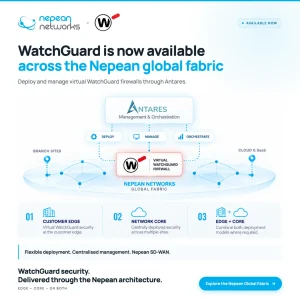
Nepean Networks Adds WatchGuard to Antares for Firewall Choice Without Lock-In
Fusion Broadband embraces Equinix in global expansion of its SD-WAN service.
Offers fast deployment of dedicated SD-WAN gateways in 50+ locations worldwide.










Fusion Broadband embraces Equinix in global expansion of its SD-WAN service.
Offers fast deployment of dedicated SD-WAN gateways in 50+ locations worldwide.
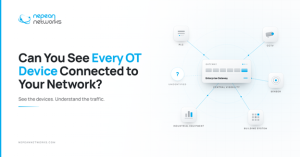
As IT and Operational Technology environments become increasingly connected, simply knowing a device is online is no longer enough. Network teams need visibility into what those devices are actually doing.

Fusion Broadband embraces Equinix in global expansion of its SD-WAN service.
Offers fast deployment of dedicated SD-WAN gateways in 50+ locations worldwide.

Digital transformation drives business success, the need for robust, adaptable network infrastructure has never been greater. Traditional Wide Area Networks (WANs) often suffer from rigidity, tying organizations to single Internet Service Providers (ISPs) or specific connectivity mediums, which can lead to vulnerabilities, high costs, and limited scalability. Enter Software-Defined Wide Area Networking (SD-WAN), a game-changing technology that decouples network management from hardware constraints. At the forefront of this evolution is Nepean Networks, whose SD-WAN solution stands out for its fully agnostic approach to last-mile telecommunications deployment. This means businesses can seamlessly integrate any ISP, operator, or connectivity type—such as fiber, LTE, satellite, or fixed wireless—into a unified, resilient network. In this article, we’ll explore how Nepean Networks’ SD-WAN achieves this agnosticism, the innovative features that power it, and the transformative benefits it delivers to enterprises worldwide. The “last mile” refers.

How Silicon Valley Hype Destroys Value, & Why Nepean Networks Actually Solves Business Problems Most networking and SD-WAN projects fail spectacularly. Not in the lab. Not in the glossy RFP responses. They fail in production, where real money, real customers and real productivity bleed out through packet loss, jittery VoIP, sluggish SaaS apps and surprise security holes. The culprits? The same tired playbook: chasing Gartner Magic Quadrant positions, reciting feature checklists and hiding behind the corporate shield of “you can’t get fired for buying Cisco” (or Palo Alto, VMware, or whichever Silicon Valley darling is currently in vogue). Vendors peddle “zero-touch provisioning,” “50% cost savings,” and “application-aware routing” like miracle cures. Executives, armed with just enough knowledge to be dangerous, buy the pitch. Network engineers who raise red flags about underlay/overlay mismatches, QoS realities, brownfield integration nightmares, or proper traffic.

In the currennt digital landscape, robust network security is essential for businesses of all sizes. Nepean Networks SD-WAN stands out by fully integrating with a range of open-source firewalls, including pfSense, OPNsense, IPFire, OpenWRT and even Debian with nftables. This integration empowers small and medium-sized enterprises (SMEs) to achieve enterprise-level protection without the hefty price tag. By deploying these firewalls as Network Function Virtualization (NFV) on SD-WAN edge devices, Nepean Networks transforms basic connectivity into a secure, manageable and scalable infrastructure.

In the complex world of modern networking, where multi-vendor environments and distributed infrastructures are the norm, Nepean Networks’ Smart SD-WAN introduces Infrastructure & Troubleshooting Intelligence as a pivotal component. This intelligence leverages tools like Secure Connect and integrated diagnostics to enable managed service providers (MSPs) and IT teams to manage upstream and downstream infrastructure seamlessly, without on-site interventions. With full access to NFV-based appliances, wire-rate packet capture via Wireshark, iperf testing and built-in speed tests, it transforms troubleshooting from a reactive process to a proactive, efficient one. Drawing from Nepean Networks’ innovative ecosystem, this article explores how Infrastructure & Troubleshooting Intelligence revolutionizes SD-WAN for MSPs handling large customer footprints.

In the high-stakes world of legal practice, where every minute counts toward billable hours and client outcomes, network reliability isn’t just a convenience—it’s a necessity. Lawyers rely on seamless connectivity to access case files, conduct research, communicate with clients and file documents electronically. Downtime or poor performance can lead to lost revenue, damaged client relationships and even ethical violations if deadlines are missed. Nepean Networks’ Last Mile SD-WAN (Software-Defined Wide Area Network) emerges as a transformative solution, optimizing the critical “last mile” of connectivity—the final link from the internet service provider to the end-user’s premises. This guide explores the pivotal role of Last Mile SD-WAN in empowering legal practices, with a deep dive into the benefits of partnering with Nepean Networks and practical deployment strategies tailored for law firms.
Why session-based SD-WAN solution cause downtimes during WAN events as it cannot reliably switch paths
SD-WAN has become the default choice for businesses seeking resilient, high-performance connectivity across multiple WAN links.

In the ever-evolving landscape of enterprise networking, Nepean Networks stands out as a global award-winning SD-WAN provider, delivering flexible, high-performance solutions since 2010. Specializing in partner-focused offerings for Managed Service Providers (MSPs) and enterprises, Nepean Networks excels in creating secure, resilient Private WANs (PWANs) that leverage advanced SD-WAN technology. What sets Nepean apart is its unique ability to run private WANs aggregated across separate data centers in diverse geographical regions, enabling highly optimized branch networks. This architecture ensures that edge nodes always connect to the closest data center, eliminating the need for inefficient hairpinning over long distances and dramatically improving performance, latency and reliability.